
• A study, led by the Botanical Institute of Barcelona (IBB), points out oceanic dispersal as the primary mechanism driving the colonization of South Pacific archipelagos.
• Leaf beetles settled down in New Caledonia during the Oligocene and dispersed to nearby archipelagos over the past 20 million years, reaching New Zealand up to three times independently.
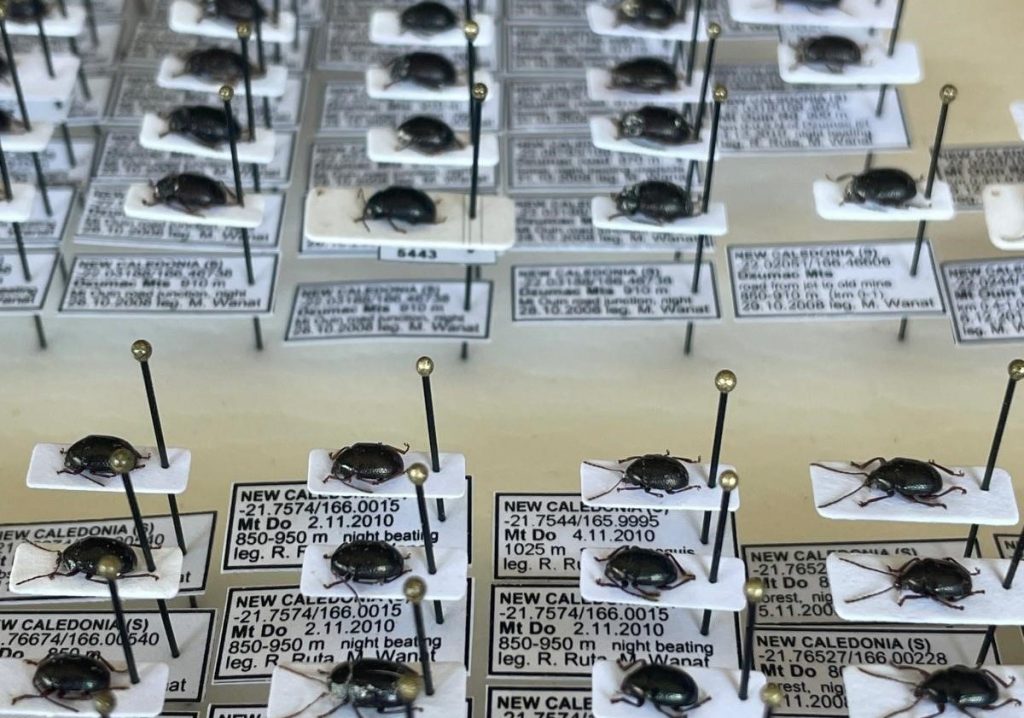
Eumolpinae are one of the most diverse subfamilies of the Chrysomelidae, commonly known as leaf beetles for their habit to feed on green parts of plants, and they are mainly distributed in the Tropics. The Eumolpinae are very diverse in the South pacific, especially in New Caledonia where, despite the relatively small size of the archipelago, more than 200 species could live there. But they are also present in New Zealand and even in the tiny and highly isolated Lord Howe and Norfolk Islands.
The Herbivore Beetle Evolution Lab of the IBB has been studying these beetles for more than 15 years, and their latest study, which has included the most informative phylogeny of Eumolpinae to date, has confirmed that all the species currently in the South Pacific derived from a common ancestor.
The study focuses on South Pacific archipelagos, particularly New Caledonia and New Zealand, which are part of the ancient continent of Zealandia, including continental terrains dating back to the Jurassic Gondwana. These regions also present volcanic and organic formations, and seemingly underwent a complex history of drowning and land resurfacing stages. In this changing geographic scenario, it appears that the most ancient stable land in the area would be Grande Terre, the larger island of New Caledonia, which would be some 37 Ma old. Areas of present-day New Zealand may have been continuously emerged throughout the history of the archipelago, but there is a relatively good consensus about cataclysmic tectonic and volcanic events mainly affecting the North Island, which may have drowned most of the island until some 22 Ma ago.
The biological aspect of these archipelagos is more controversial, and the origin of their biodiversity remained a subject of debate among scientists. “These islands have a very special and unique biota characterised by many endemic lineages,” points out Leonardo Platania, co-first author of the study, “and this has led to an open debate about their origin.”

Understanding the distribution and evolution of species requires understanding the geological history of the islands.
Each taxonomic group has been subject to different processes and histories, and for delineating the big picture of evolution and biogeography of this complex region it is important to study as many different groups as possible. «Our study is relevant towards the biogeographic synthesis of the South Pacific, among other things because of its focus on a taxonomic group, the Eumolpinae, widely distributed and highly diverse in all the archipelagos of the region«, explains Jesús Gómez-Zurita, senior author of the study and researcher at the Botanical Institute of Barcelona (IBB), mixed research centre of the Spanish National Research Council (CSIC), and the Natural Science Museum of Barcelona (MCNB).
The phylogenetic study, which examines the evolutionary relationships among species, has confirmed the monophyletic origin of the South Pacific leaf beetles, which implies that all current species in this region descended from a common ancestor that diverged from other Eumolpinae lineages around 45-75 Ma ago, during a period of significant transformations on the eastern margin of Gondwana.
However, there was a long period between the origin of South Pacific Eumolpinae and their diversification, where the closest relatives apparently did not leave extant descendants or could not be identified. This pattern is consistent with extinction, which together with the uncertainty about the geographic origin of the group raised a suggestive hypothesis. According to it, South Pacific Eumolpinae could be the descendants of a group originally distributed in Western Antarctica, still connected to Gondwana and with warm climate in the Late Cretaceous, which went extinct when Antarctica acquired its current harsh climatic conditions.
The study also found that the main process generating diversity in region has been in situ diversification, the formation of new species in each island once the beetles reached them, and that most South Pacific islands were colonized by New Caledonian transoceanic migrants, with the only exception of Norfolk Island that may have been colonized from New Zealand. In this system, dispersal is explained as a process where small animals or seeds migrate across the ocean, perhaps hitching rides on floating land or plant debris or being carried by storms. In South Pacific Eumolpinae, dispersal had to be assumed in every case because the age of the island groups was always posterior to the origin of the island itself. Of particular interest, these rare events of dispersal occurred at least three times independently from New Caledonia to New Zealand during the Miocene, highlighting the relevance of long distance dispersal in island biogeography, although some studies still make plausible the idea of Gondwanan relicts in these islands for other organisms (the so-called, vicariance hypothesis).
«Eumolpinae show a rather exceptional biogeographic pattern in the South Pacific, with New Caledonia acting as the source of diversity in the region, when for most other organisms, larger islands, like New Zealand or, of course, Australia, are the dominant centres of dispersal in the region«, says Anabela Cardoso, co-first author and researcher at the Gómez-Zurita lab, «and our study also shows how important rare oceanic dispersal can be for the evolution of life«. Invoking long-distance transoceanic dispersal for small organisms with limited dispersal ability a priori and unable to survive in marine water immediately raises questions about how this process could lead to effective colonization of distant, isolated parts of the World. Chance and the long evolutionary time periods allowing for improbable events are part of the answer, but intrinsic biological characteristics of the organisms could be involved too, increasing precisely the chances of improbable events to occur. «Considering the subterranean habits of larval stages of Eumolpinae, their transportation in lumps of soil attached to roots of large fallen trees carried by the sea could explain survival through harsh marine conditions until eventual arrival on land«, reckons Platania.
«This study adds to the growing knowledge on the diverse biogeographic histories that shape the extraordinary diversity of life in the South Pacific and provides a sound and interesting alternative to long-distance dispersal routes commonly found for this region, highlighting both the importance of dispersal and how it is also conditional on the actual biology of the organisms under study» concludes Jesús Gómez-Zurita.
Reference article:
Platania, L., Cardoso, A., Anderson, M., Fikáček, M., Gauthier, J., Hendrich, L., Mille, C., Morii, Y., Reid, C. A. M., Seidel, M., Morgan-Richards, M., Trewick, S. A., Toussaint, E. F. A., & Gómez-Zurita, J. (2024). New Caledonian rovers and the historical biogeography of a hyperdiverse endemic lineage of South Pacific leaf beetles. Systematic Entomology. https://doi.org/10.1111/syen.12632